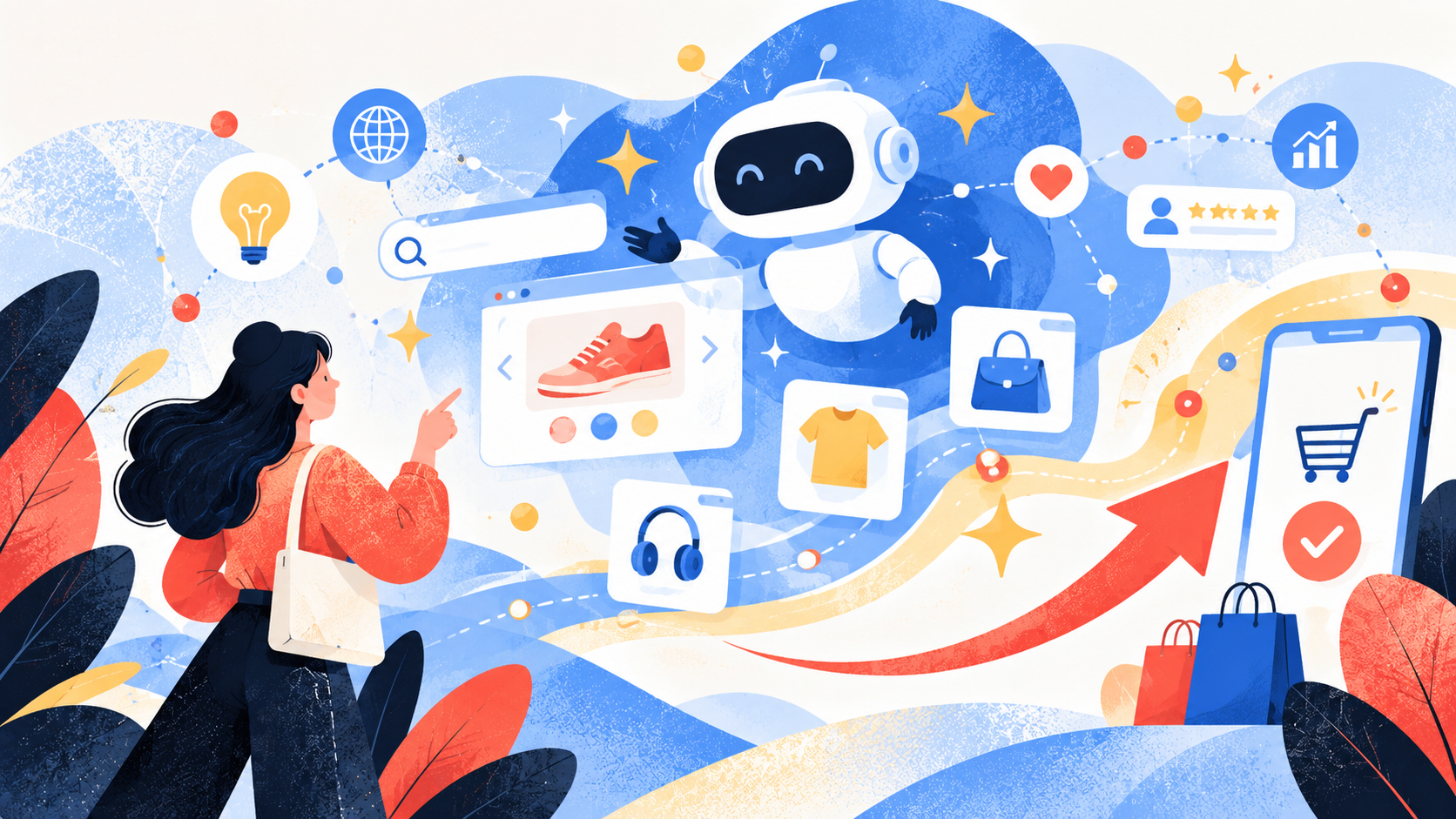
For years, marketers designed customer journeys around a person moving between search engines, websites, social platforms, reviews, and e-commerce stores. In 2026, another participant is entering that journey: the AI agent. An agent can research, compare, summarize, filter, recommend, and in some cases complete parts of a task on behalf of the customer.
This is more important than adding another chatbot to a website. It changes how discovery and evaluation happen. A customer may no longer visit ten product pages personally. Instead, the customer might ask an AI system to compare ten options and return the three that best fit a specific set of requirements.
Marketing Is Starting to Happen Through an Intermediary
Imagine a buyer looking for a laptop. The traditional journey might involve Google searches, YouTube reviews, retailer pages, Reddit discussions, and specification comparisons. An AI-assisted journey could begin with one request: “I need a lightweight laptop under $1,500 for research, data analysis, video calls, and occasional Premiere Pro work. Battery life matters and I do not want a gaming laptop.”
The agent now becomes part of the decision process. It may eliminate most unsuitable options before the customer sees them. That means product information needs to be useful not only to the human shopper but also to the system helping the shopper.
Machine-Readable Information Becomes Commercially Important
An AI agent cannot recommend what it cannot understand. Businesses should therefore publish product and service information in a clear, structured, factual way. Marketing language still has a place, but it should not replace decision information.
- Pricing or pricing logic where appropriate.
- Specifications and compatibility information.
- Availability and delivery details.
- Warranties and return policies.
- Use cases and limitations.
- Customer reviews and evidence.
Compare “Our revolutionary solution transforms productivity” with “Cloud-based project-management software for teams of 10–200, with role permissions, time tracking, Slack integration, and a 14-day trial.” The second statement gives both humans and machines something concrete to evaluate.
Trust Becomes Part of the Conversion Architecture
Delegating product discovery does not mean customers will delegate every decision. Many people may allow an AI system to narrow the options while still wanting to validate the final choice themselves. That validation stage is where trust becomes critical.
Strong businesses will make it easy to verify claims. They will show reviews, company information, security policies, customer-support options, demonstrations, return conditions, and realistic product limitations. Exaggeration becomes more dangerous when users can compare alternatives instantly.
The Funnel Becomes Less Linear
Traditional funnel diagrams often assume a neat path from awareness to consideration to conversion. Agentic systems make that path more compressed and less predictable. A user might move from a broad problem to a shortlist in one conversation. Another user may begin with a known brand and ask an agent only to validate whether it is still the best choice.
That is why brands need content for multiple levels of intent. Educational articles explain the problem. Comparison pages support evaluation. Product pages provide facts. Case studies and reviews reduce risk. Videos demonstrate the experience. FAQs remove uncertainty.
Brands Need to Serve Two Audiences at Once
The machine needs clarity, structure, and accurate information. The person needs confidence, relevance, emotion, and proof. Optimizing for only one side is risky.
A technically perfect product feed cannot create a compelling brand. A beautiful brand story cannot compensate for missing specifications, unclear pricing, or contradictory product information. The strongest companies will combine both.
What Marketers Should Do Now
Marketers do not need to predict every future agent platform. They need to improve the quality of the information environment around the brand. Audit how clearly your website explains products, services, policies, differences, and evidence. Remove vague claims. Strengthen comparison content. Build first-party customer data. Make your brand easier to verify.
Agentic AI will not eliminate branding. In a market where machines can surface hundreds of alternatives quickly, a trusted and distinctive brand may become even more valuable. The competitive advantage will belong to companies that are easy for machines to understand and easy for humans to believe.
Muhammad Al Ori
Business Development and Marketing Strategy