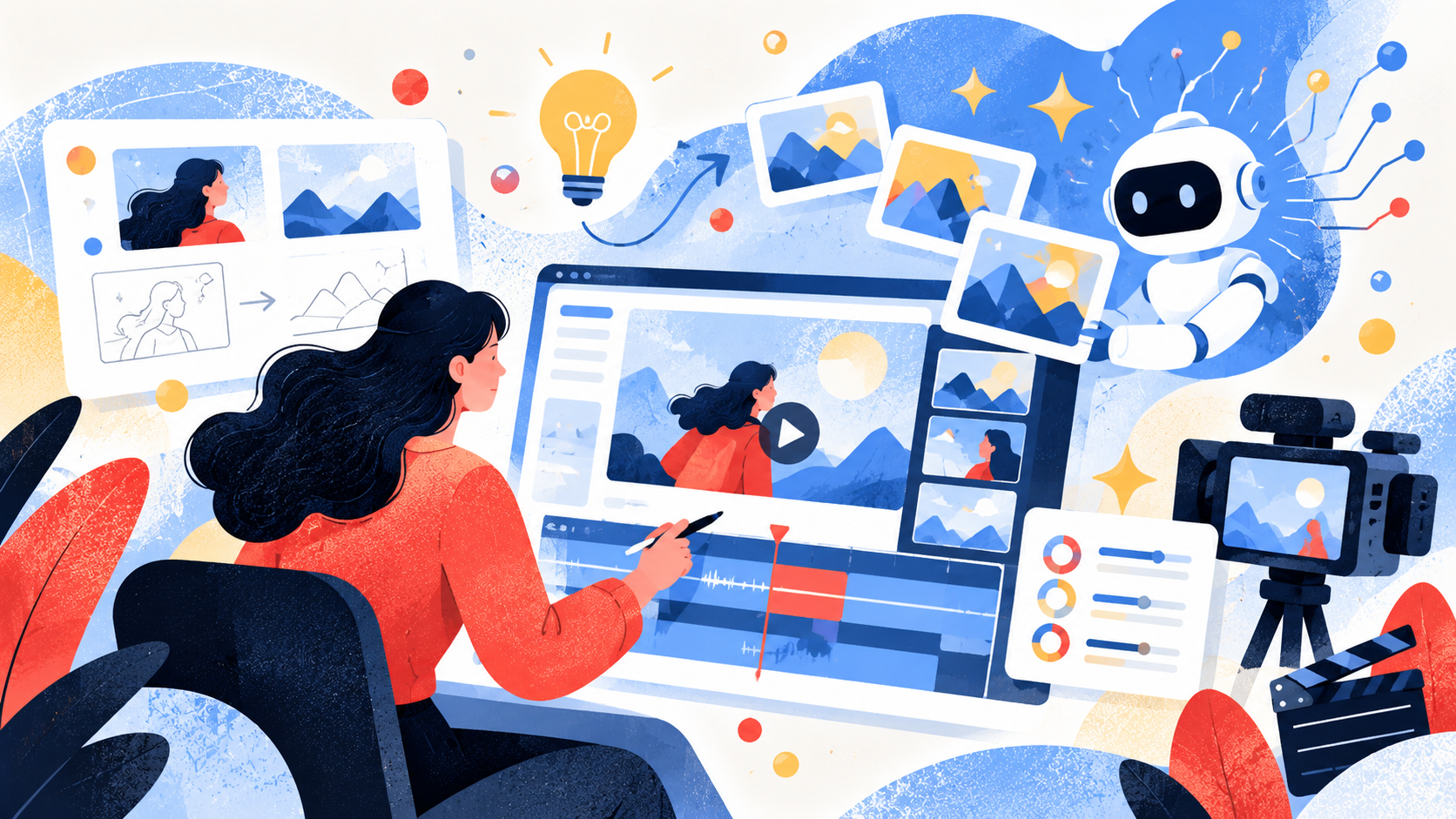
Generative AI is changing video production at almost every stage. Marketers can now use AI to explore concepts, draft scripts, generate storyboards, clean audio, create visual elements, produce voiceovers, translate content, resize formats, and build variations much faster than before.
This efficiency is real, but it creates a misunderstanding: if production becomes easier, some people assume creative professionals become less important. In reality, the opposite can happen. When everyone can generate content, the ability to choose what is worth making becomes more valuable.
AI Is Excellent at Producing Options
Before generative tools became common, developing ten visual directions could require significant time from copywriters, designers, editors, and producers. AI can now help a creative team explore many rough possibilities quickly.
That is useful because early exploration should be cheap. The challenge is deciding which concept fits the brand, which claim is believable, which emotional tone is appropriate, and which execution will stand out. Those are creative-direction decisions, not generation tasks.
Faster Production Can Create More Bad Content
When a company can produce twenty videos in the time it previously took to create two, volume naturally increases. The internet therefore receives more content, not necessarily better content.
As production becomes abundant, distinctiveness becomes scarce. A strong creative concept, original footage, recognizable voice, and real customer insight become more valuable because they are harder to reproduce with a generic prompt.
Use AI Across the Production Workflow
Pre-production
AI can support research organization, concept development, script alternatives, interview questions, shot lists, mood-board exploration, and rough storyboards. It is particularly useful for reducing the blank-page problem.
Production
During production, AI can assist with virtual backgrounds, teleprompter workflows, voice cleanup, visual extension, asset generation, and certain forms of scene creation. The appropriate use depends heavily on the brand and the purpose of the video.
Post-production
This is already one of the strongest areas for AI. Transcription, captioning, rough cutting, silence removal, format conversion, audio improvement, translation, and version generation can reduce repetitive editing work significantly.
Do Not Remove Every Human Imperfection
Real people do not speak like corporate scripts. Customers pause. Founders use personal expressions. Offices have small imperfections. Interviews contain emotion that would be difficult to reproduce artificially.
Those details can create trust. AI should improve communication without polishing away every sign that a real person exists behind the brand.
Build a Hybrid Workflow
A practical modern workflow might look like this:
- The human team defines the commercial objective.
- AI helps explore concepts and variations.
- A creative lead selects the strongest direction.
- AI accelerates repetitive production tasks.
- Humans review factual accuracy, brand fit, and emotional tone.
- AI helps create platform-specific versions.
- A human approves the final asset.
This approach captures speed without surrendering judgment.
Original Footage Becomes a Strategic Asset
Customer interviews, founder videos, product demonstrations, events, workplace footage, research presentations, and real case studies give a brand material competitors cannot simply recreate with a prompt.
AI can repurpose those assets, but the source material remains uniquely yours. That makes original production even more important in an AI-saturated content environment.
The Future Is Hybrid, Not Fully Automated
The strongest video teams will not reject AI, and they will not allow AI to define the brand by itself. They will use technology for speed while protecting the human elements that create taste, judgment, credibility, and emotional relevance.
Production is becoming easier. Creative direction is becoming more important. That is the real shift.
Muhammad Al Ori
Business Development and Marketing Strategy